
The B2B e-commerce landscape is booming. Fuelled by the evolving needs of business buyers, sales between businesses are surging.
Gartner predicts 80% of B2B sales transactions will occur digitally by 2025, while McKinsey & Company reports nearly two-thirds (65%) of B2B companies now offer e-commerce capabilities.
B2B e-commerce allows businesses to buy and sell goods and services online. Unlike B2C transactions, B2B purchases often involve complex orders, larger quantities, and unique customer needs.
Contents:
- The consumerised B2B buyer
- Why B2B e-commerce is a win-win
- Benefits for merchants
- Benefits for buyers
- Is B2B e-commerce right for you?
- Building your customer centric B2B e-commerce store
- Personalisation is key
- How to incorporate personalisation into B2B e-commerce
- Security and compliance
- The future of B2B e-commerce is customer-centric
The consumerised B2B buyer
Today’s B2B buyers expect a convenient and user-friendly online experience, similar to what they’re accustomed to in their personal shopping. This presents a significant opportunity for B2B merchants.
For example, in the UK, the share of B2B organisations’ revenue which comes from digital channels increased from 32% in 2020 to 44% in 2022. In 2024, it is projected to be 57%.
This shift highlights the growing appeal of B2B e-commerce compared to direct-to-consumer (DTC) models, which typically involve lower order volumes and higher customer acquisition costs.
Why B2B e-commerce is a win-win
B2B e-commerce offers advantages for both buyers and merchants.
Benefits for merchants:
- Reduced costs – streamlined order processing and lower operational expenses.
- Increased sales – reach a wider audience and facilitate repeat business.
- Improved customer relationships – offer a more convenient buying experience and strengthen buyer loyalty.
- Enhanced customer experience – B2B platforms can deliver personalised experiences with features such as customised pricing.
- Higher order value and volume – businesses typically buy in bulk, leading to more revenue per sale.
- Lower customer acquisition costs – established B2B relationships eliminate the need for expensive acquisition tactics.
- Predictable revenue – long-term B2B customer relationships create a stable income stream.
Benefits for buyers:
- Convenience and efficiency – order anytime, anywhere with 24/7 access and self-service options.
- Transparency and control – real-time order tracking, product availability updates, and clear pricing information.
- Improved decision-making – access to detailed product information and specifications for informed purchases.
Is B2B e-commerce right for you?
Before diving into B2B e-commerce, consider these factors:
- Product complexity – highly technical products may require additional support features beyond a basic online store.
- Customer base – are your buyers comfortable with online transactions or do they require and more personalised touch?
- Consumerisation alignment – can your offerings be presented in a way that caters to the expectations of consumerised buyers?
Building your customer centric B2B e-commerce store
Here’s how to create a B2B online store that prioritises the customer experience:
- Platform selection – choose a platform that offers features such as personalised product recommendations and advanced search functionalities.
- Product information – provide comprehensive and accurate details, including high-quality images, clear descriptions and technical specifications.
- Customer experience – design a user-friendly interface that mimics consumer-grade online stores. Include features such as self-service portals, order tracking and readily accessible customer support.
Personalisation is key
A 2023 global survey revealed that seven out of ten business leaders are increasing their investments in personalisation.
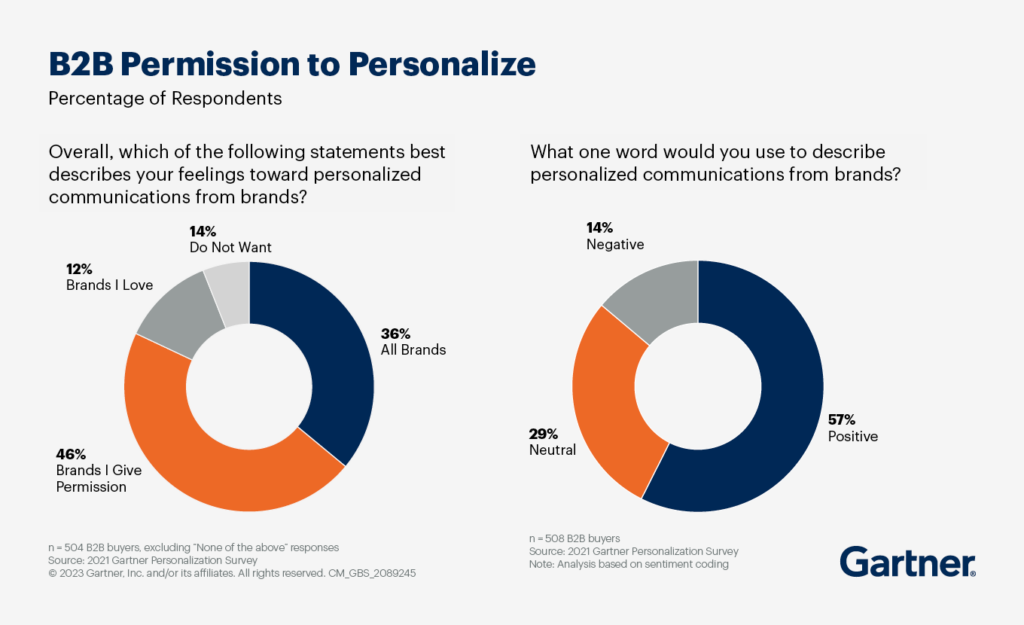
Gartner highlights that B2B buyers are becoming more receptive to personalised communication from brands, with 82% of B2B buyers wanting personalised communications from all brands or brands they give permission to.
How to incorporate personalisation into B2B e-commerce
- Targeted product recommendations based on purchase history.
- Dynamic pricing for volume purchases.
- Personalised account dashboards.
Security and compliance
Emphasise robust data security measures to build trust with buyers who entrust you with sensitive business information.
The future of B2B e-commerce is customer-centric
The way businesses buy and sell is undergoing a significant transformation. B2B e-commerce is the future of efficient and convenient transactions. By prioritising the consumerised buying experience, companies can gain a competitive advantage and forge stronger relationships with their B2B customers.
Ready to embrace the future with B2B e-commerce? We can help! Contact us today.
Further reading: Who uses Adobe Commerce and its benefits to B2B businesses