
We recently attended a webinar delivered by Shaun McCran, Product Marketing Manager at Adobe, focusing on the exciting new directions for the platform: Adobe Commerce as a Cloud Service and Adobe Commerce Optimizer.
As an agency that lives and breathes ecommerce, we believe the platform you choose is just the foundation. Adobe’s roadmap clearly shows they are shifting focus from platform maintenance to pure business growth – which is exactly what our clients need.
Addressing Merchant Pain Points
For years, the industry has faced a set of stubborn challenges. Adobe Commerce’s origins in the Magento acquisition provided a strong and proven foundation. In recent years, Adobe has focused on evolving and modernising this core into a truly enterprise-grade solution built for SaaS services, resilience and scale.
Setting the scene for the presentation was Adobe’s candid summary of the pain points ecommerce leaders (our clients!) are struggling with right now. These issues directly inform where we are directing our strategic efforts for our clients:
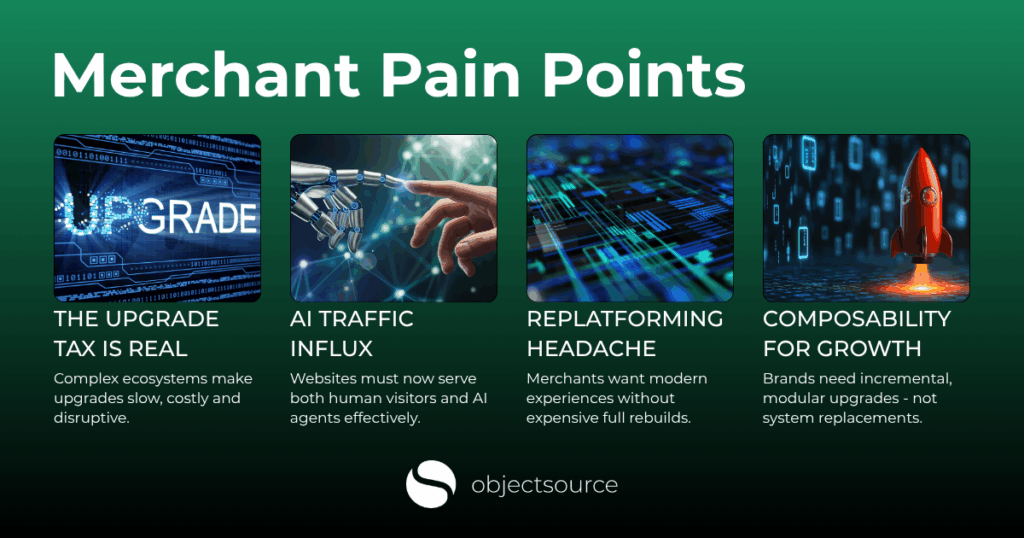
The Key Merchant Challenges
- The Upgrade Tax is Real – Maintaining and upgrading a complex ecosystem – PIMs, ERPs, fulfilment and the commerce engine itself – is expensive, difficult and slows down innovation. The market is crying out for ways to reduce these operational costs.
- The AI Traffic Influx – It’s no longer just about attracting human visitors via SEO, organic traffic and PPC. We are seeing a significant volume of AI-agentic traffic driven by LLMs such as ChatGPT. Your platform must be optimised not just for Google’s traditional crawlers, but for these new digital agents, as this profoundly impacts conversion rates.
- The Replatforming Headache – Clients rarely want to replatform; they only do it out of necessity. It’s costly and disruptive. The demand is clear: How can we get modern, high-conversion experiences without a complete rip-and-replace?
- Composability for Complex Growth – When expanding globally or targeting new B2B/B2C models, you need flexibility. The path forward must not require a full system replacement. Instead, it should involve incremental, composable modernisation that allows you to easily bolt on new features.
The Four Goals of Adobe’s Platform
Adobe’s response to these challenges is built on four distinct, actionable principles. We are aligning our services and recommendations with these goals to ensure every client investment drives tangible results:
- Maximise Conversion – Conversion is the ultimate KPI. Adobe is delivering tools and services designed to generate significant uplifts, making it easier for us to move the needle on your revenue targets.
- Accelerate Business Expansion – The platform is being engineered for touch-of-a-button replication across new brands and geographies. For merchants looking to scale across Europe or launch new ventures quickly, this speed provides a decisive competitive advantage.
- Empower the Merchandiser – Leveraging Adobe’s world-class tools (such as Photoshop and Firefly), the focus is shifting to empowering content and merchandising teams. We can now deliver richer, highly personalised experiences faster and without continuous IT dependencies.
- Drive Down Total Cost of Ownership (TCO) – Ultimately, efficiency is key. Adobe is committed to helping businesses achieve all three goals above while simultaneously cutting operational and maintenance costs.
This strategy sets the foundation for two critical products that will change the way we approach ecommerce architecture: Adobe Commerce as a Cloud Service (SaaS) and the highly flexible Adobe Commerce Optimizer.
Adobe Commerce as a Cloud Service: True SaaS
While Adobe Commerce Optimizer provides flexibility for hybrid approaches, the full Adobe Commerce as a Cloud Service (ACCS) offering delivers pure, enterprise-grade SaaS designed for maximum efficiency:
- Always Up to Date – ACCS is a full SaaS solution that removes the burden of upgrades and patches entirely. Adobe manages all core updates, guaranteeing you’re always running the latest, most secure version.
- Simplified Onboarding and Elastic Scale – Instances can be provisioned in minutes via a streamlined cloud dashboard. Crucially, ACCS is elastic and auto-scales to meet peak demand, eliminating manual performance concerns during high-traffic periods.
- Integrated Core Services – Key features (such as Live Search, Product Recommendations and Payment Services) are now pre-integrated into the core platform. This drastically reduces implementation time and effort, removing foundational hurdles that previously slowed down time-to-market.
Adobe Commerce Optimizer for Flexible Modernisation
The most exciting takeaway for us, from an architectural flexibility standpoint, is Adobe Commerce Optimizer. This product directly addresses the “replatforming headache” mentioned earlier.
Adobe Commerce Optimizer is a storefront solution powered by Edge Delivery Services and integrated with Adobe’s powerful services (AEM Assets and Merchandising Services). Crucially, it’s designed to sit on top of any existing commerce backend – be it SAP, Salesforce, Commerce Tools, or a version of Magento/Adobe Commerce (PaaS).
Key Use Cases for Adobe Commerce Optimizer
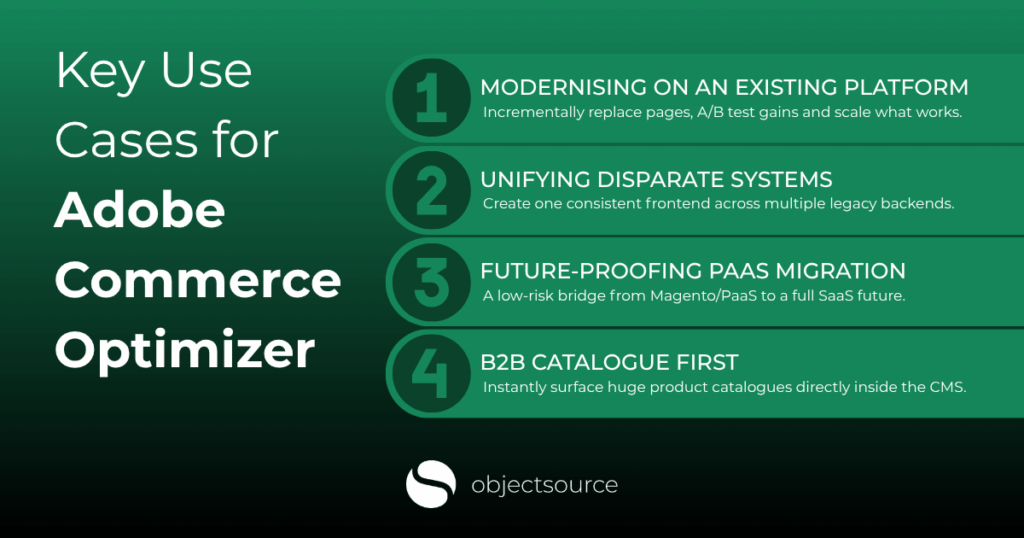
We see four immediate, high-impact ways our clients can leverage Adobe Commerce Optimizer:
- Modernising on an Existing Platform – You don’t have to throw away your current storefront. Adobe Commerce Optimizer allows for incremental replacement. For instance, you could launch a new, high-performance Product Detail Page (PDP) powered by Adobe Commerce Optimizer just for one product category. You can then A/B test its performance against your existing solution to prove ROI before scaling.
- Unifying Disparate Systems (The B2B Challenge) – We heard a compelling example of a large German B2B customer operating across 32 countries with four different commerce backends. Their front-end experience was inconsistent and fragmented. Adobe Commerce Optimizer is being used to build one unified experience layer that sits across all those legacy systems. It allows them to grow without the crippling demand of decommissioning multiple mission-critical platforms.
- Future-Proofing PaaS Migration – If you are currently using Magento/Adobe Commerce (PaaS) and planning a move to the full SaaS offering, Adobe Commerce Optimizer is the perfect bridge. It allows for a gradual, less risky transition: you can shift your catalogue and assets into the new cloud model and start replacing legacy PHP plugins with modern App Builder apps.
- B2B Catalogue First – For B2B clients who need to rapidly get massive product catalogues (millions of SKUs) online for rich content experiences (such as detailed product articles and research) but may still rely on offline transactions, Adobe Commerce Optimizer provides the product data right inside the CMS (such as AEM) instantly.
The High-Performance Storefront
Adobe is betting heavily on performance – and for good reason. For both human visitors and AI agents (LLMs), speed dictates conversion and organic ranking.
- Four Times Faster Page Load Speeds – The new architecture is consistently demonstrating sites launching with 90+ Lighthouse scores – green across all Core Web Vitals.
- Boost in Organic Traffic – Simply by improving site speed, clients are seeing immediate increases in organic visibility, which is the holy grail for reducing reliance on paid channels. This performance uplift allows a merchant to rethink their PPC strategy, potentially redeploying budget away from expensive branded keywords.
The new visual editor makes creating these fast, engaging experiences simple. It’s a WYSIWYG (What You See Is What You Get) interface where merchandisers can create and manage content without requiring IT involvement, which is crucial for agility.
The Composable Catalogue is Built for B2B Scale
Adobe has completely re-engineered the catalogue model to handle enterprise complexity without data duplication. This is where the platform truly shines for global and B2B clients:
- Massive Scale, Single Source – The platform is built to handle over 250 million SKUs in a single catalogue. The key is having one copy of the product data with different views and access levels applied on top.
- Geographic and Segment Expansion in Hours – This flexibility is transformative for accelerating international growth. For example, a US-based multi-brand retailer can duplicate their US price book, rename it for the UK market, and selectively apply only Brands A and D, all without spending weeks duplicating product data.
- AI-Powered Merchandising – Merchandisers can define promotions by applying rules across the catalogue. For example, search for “all blue jumpers” (or even synonyms for blue) and apply a 10% discount instantly, saving massive manual effort compared to editing individual products.
Asset and Content Supply Chain Synergy
The integration of the commerce platform with Adobe Experience Manager (AEM) Assets is bridging the gap between marketing and merchandising. This provides a single, governed place for all digital assets, improving brand consistency from email campaigns to the product page.
- On-the-Fly Image Variations – Merchandisers can take a standard product image, select the background and use a simple text prompt (e.g., “autumn theme with leaves”) to generate a new, high-quality image variation in seconds.
- Hyper-Personalisation – This capability allows for instant personalisation. An audience segment located in Florida can be served a product image with a beach background, while a New York audience sees the same product with a city skyline – all customised on the fly to connect the customer to the product more quickly and efficiently.
The AI Agent for Site Health
To maintain this performance, Adobe is rolling out an AI agent focused on automating site health. It performs tedious discovery tasks such as finding broken backlinks and identifying organic traffic issues, offering recommendations or even auto-fixing errors to ensure continuous optimal performance.
Real-World Success & Client Results
The most convincing evidence of Adobe’s platform shift lies in the results clients are already seeing. During the presentation, Adobe shared a compelling series of case studies demonstrating the power of this new composable architecture. These metrics validate our excitement about the platform’s ability to drive tangible growth:
Case Studies – Performance and Efficiency
- Large B2C Retailer (North America) – This early adopter saw a 2x increase in unbranded organic traffic within just two months of launching the new storefront. Our takeaway is clear: the high Lighthouse scores and superior performance translate directly into massive SEO gains, which reduces the business’s reliance on expensive PPC spend.
- Global B2B/B2C Lighting Supplier – This customer needed proof. Adobe executed a two-week Proof of Concept (POC) that moved their performance score from 8 to 90+. This highlights the platform’s composable power – the client could incrementally improve their homepage, PDPs and even built a real-time quoting system (via App Builder) without a major re-platforming project. They now have the agility to launch a new B2C store easily.
Case Studies – Personalisation and Revenue
- Global Consumer Brand – By leveraging the data synergy between Adobe Marketing and Commerce solutions for personalised, multichannel offer management, this brand achieved a 41% increase in conversion rate and a 12% uplift from abandoned cart re-engagement.
- B2B Educational Supplier – This B2B firm implemented a mobile-first, data-driven personalisation approach that led to increased revenue and conversion, and a decreased bounce rate across the board, successfully opening up new market opportunities in the B2C segment.
Ultimately, every successful client story Adobe shared proves that the platform’s core metric is driving Gross Merchandise Value (GMV) and engagement, not enduring technical debt or re-platforming projects.
Our Verdict
Adobe is no longer just selling a platform; they are providing an ecosystem of composable services designed to solve modern ecommerce problems: high costs, slow sites and restrictive legacy architecture. Both Adobe Commerce as a Cloud Service and Adobe Commerce Optimizer give us, as an agency, the powerful tools we need to deliver high-speed, personalised, and efficient growth for your business, regardless of your current platform starting point.
Schedule a consultation to discuss how Adobe Commerce Optimizer or the move to SaaS could benefit your specific commerce architecture.
This blog post is based on an Adobe presentation delivered to partners and customers.